
Pokhara Sports/ Women’s football in South Asia has long faced challenges-ranging from limited investment and societal barriers to a lack of competitive exposure. However, recent years have shown encouraging signs of transformation. While progress remains uneven across the region, the collective trajectory is undeniably upward.
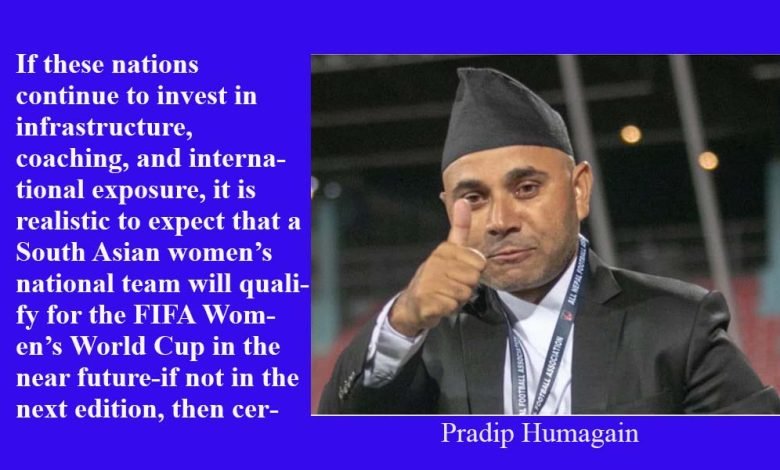
Pradip Humagain is a Nepal-born, U.S.-based football coach and the first Nepali to hold a FIFA Pro License. He recently completed a Technical Director’s Diploma from CONMEBOL in Argentina, marking another milestone in his global coaching career. Formerly the head coach of Nepal’s national team and clubs like Three Star Club and Lalitpur City FC, he has also worked with U.S. teams including Keystone Athletic and Philadelphia Union Academy. Known for his academic and tactical depth, Humagain is a trailblazer in South Asian football coaching.
India has traditionally been at the forefront, with its women’s national team consistently ranked among the top in South Asia. The Indian Women’s League (IWL), launched in 2016, has provided a structured platform for talent development, supported by regional academies and growing corporate interest. Despite not yet qualifying for the Women’s World Cup, India continues to be a benchmark in the region.
Bangladesh has made significant strides, particularly at the grassroots level. The success of their U-19 and U-15 girls’ teams—winning SAFF championships and gaining international recognition-reflects a strong development pipeline. The Bangladesh Football Federation’s emphasis on school-level tournaments has played a pivotal role.
Bhutan, though a smaller football nation, has been quietly building a foundation by integrating women’s football into its national sports strategy. Regular youth tournaments and regional cooperation have helped maintain momentum.
Pakistan, after years of administrative issues and a prolonged FIFA suspension, has made an impressive return. The revival of women’s competitions and international friendlies, along with strong leadership within the federation, demonstrates Pakistan’s renewed commitment. The recent performance of the women’s team and efforts to scout and engage the diaspora point to a promising future.
Nepal has shown immense potential, with a passionate fan base and talented female players. However, internal divisions and inconsistent support have hindered further growth. With the right vision and backing, Nepal could emerge as a regional leader, having already reached multiple SAFF finals and produced technically skilled players worthy of international exposure.
Sri Lanka is another emerging example, with increased institutional focus and a long-term plan in place. Their efforts to rebuild after past setbacks showcase resilience and forward thinking.
While the pace of development varies, one thing is clear: the momentum for women’s football in South Asia is growing. If these nations continue to invest in infrastructure, coaching, and international exposure, it is realistic to expect that a South Asian women’s national team will qualify for the FIFA Women’s World Cup in the near future-if not in the next edition, then certainly soon after.
The region has the talent, the passion, and increasingly, the vision. Now is the time for collective action, regional cooperation, and long-term planning to ensure that women’s football in South Asia reaches the global stage.