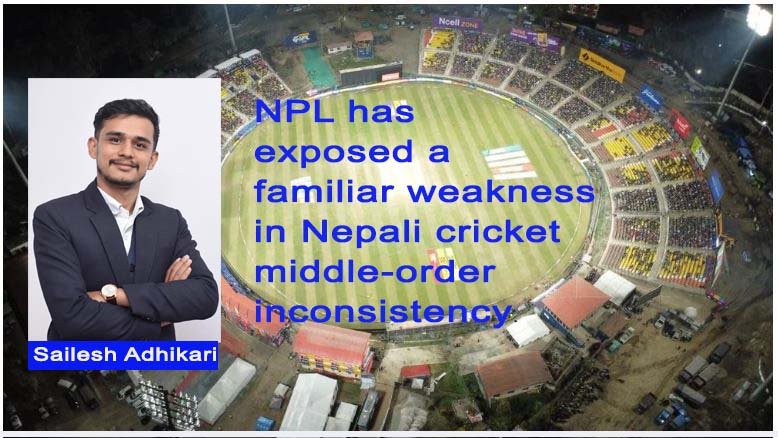

Pokhara Sports/ Sailesh Adhikari– As the Nepal Premier League (NPL) approaches its business end, one compelling question continues to dominate cricketing discussions: who truly stands as Nepal’s most reliable T20 middle-order batsman?
In a short span, the NPL has emerged as a game-changer for Nepali cricket. With eight regional franchises competing in a structured round-robin format, the league has introduced consistent, high-pressure T20 cricket at the domestic level—an experience once limited largely to international matches. The result has been a visible rise in competitiveness, professionalism, and fan engagement.
Significant upgrades at the TU International Ground, including improved seating and floodlights, have transformed the viewing experience and enabled night matches for the first time at this scale. More importantly, the league has brought financial security and wider recognition to both emerging and established players, allowing them to test their skills alongside overseas professionals.
Yet, amid the success, the NPL has also exposed a familiar weakness in Nepali cricket: middle-order inconsistency. While proven finishers like Dipendra Singh Airee and Kushal Malla continue to deliver impactful performances, a noticeable gap remains between them and the next generation of domestic middle-order batters. This concern has reignited discussions around long-term player development, conditioning, and depth in the talent pool.
Overall, the NPL has been a landmark success—elevating standards, igniting fan passion, and strengthening the cricketing ecosystem. At the same time, it has thrown up a vital challenge for Nepali cricket: identifying and grooming the next dependable T20 middle-order match-winner.